
Waiting feels like movement when neither person has agreed on the destination.
Volume oneEstablished 2026
Nadia Luong Living Library
Poetry as intellectual discovery
Each poem returns to something ordinary, experienced, witnessed, or closely observed, and gives language to something you may have felt for years without ever being able to name.
WhatBecomesVisible
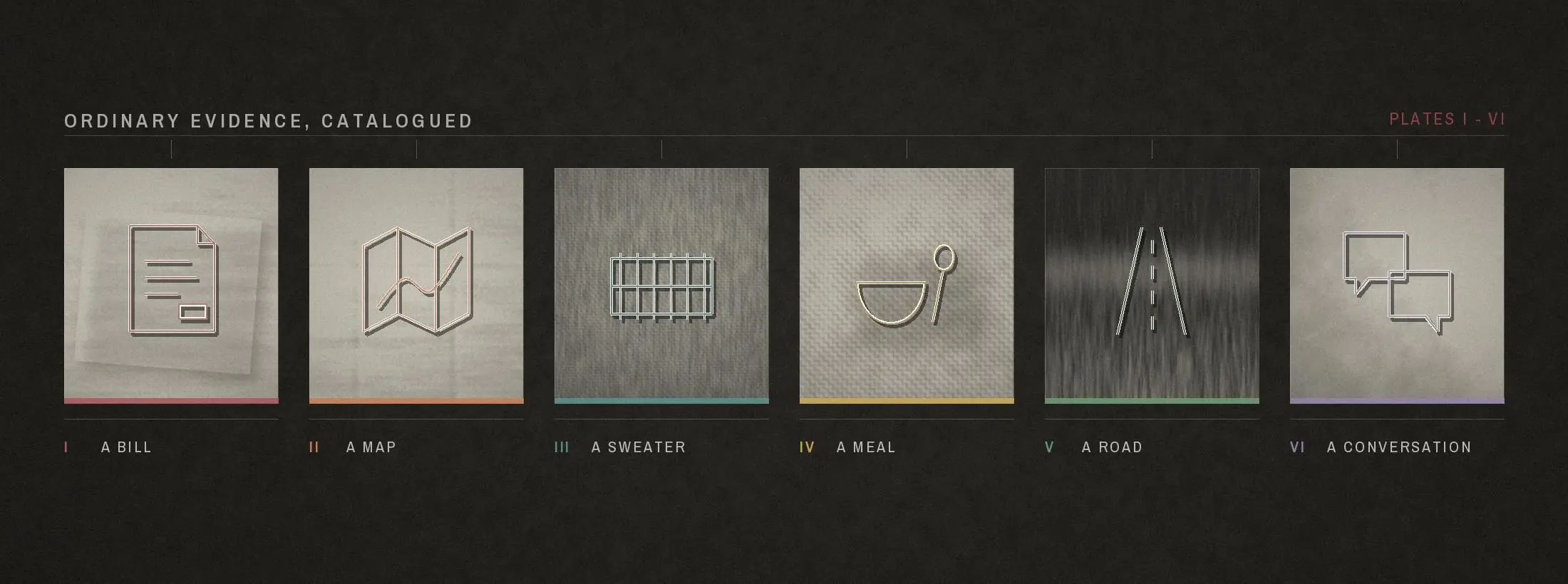
PLATES I – X
Plates from the archive









03
The poems begin
The poems begin
with what can be seen.
Every poem starts from something that can be held, counted, remembered or read. The interpretation comes second, and it is the interpretation the poem reopens.
What else becomes visible when we look again?
04The writer
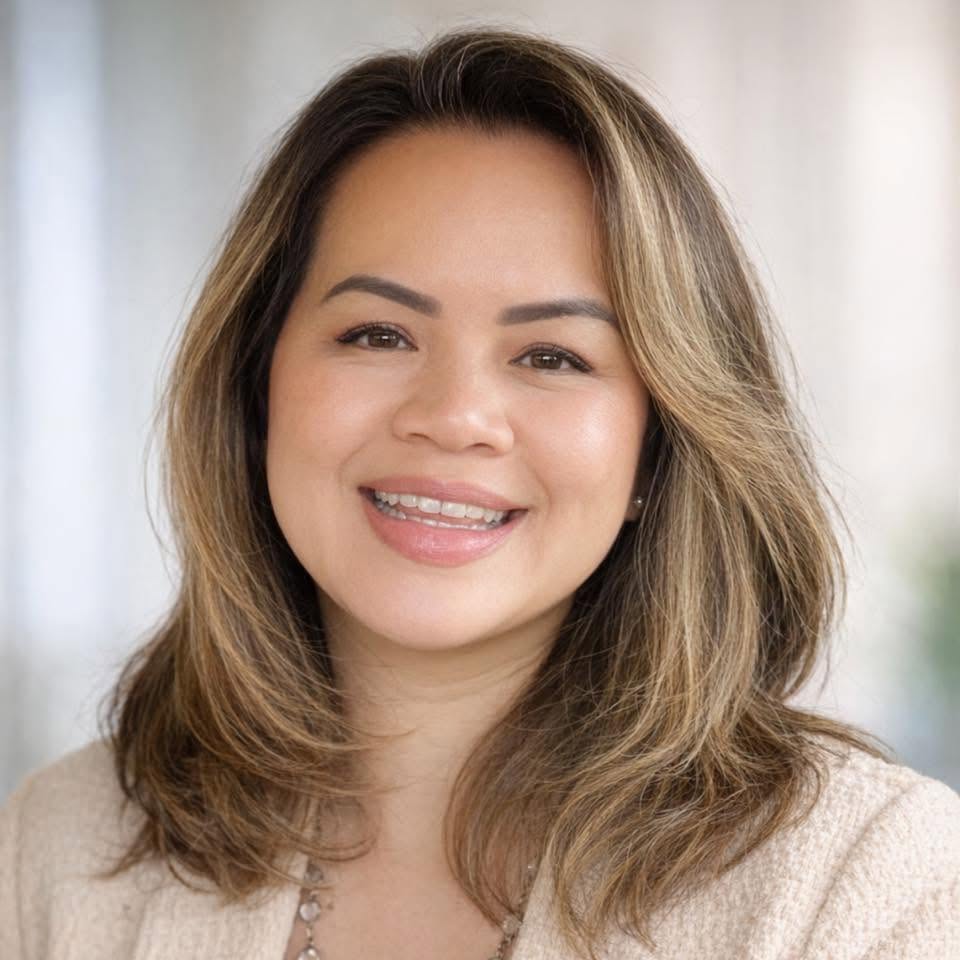
PORTRAIT — N. LUONGPoet & Writer
Nadia Luong
Nadia Luong is a first-generation Cambodian American poet based in Massachusetts, the founder of Nadia Luong Studio, and the creator of the Nadia Luong Living Library, a sole-authored archive of more than two hundred poems examining immigrant childhood, language brokering, parentification, family responsibility, marriage, motherhood, class mobility, and cultural inheritance.
Luong began language brokering for her family at an early age, translating for her parents as they navigated life in the United States. Those years taught her that translation was rarely only about words. It required listening for context, intention, responsibility, and the meaning underneath what was being said. It also taught her something that would later become central to her poetry: two truths can exist at the same time without canceling each other out.
That way of seeing became one of the roots of Luong’s poetry and, eventually, the Forensic Lyrical Method. Across her growing body of work, she began returning to concrete details, witnessed, observed, or personally experienced, and asking what those details revealed when an earlier interpretation was examined again. The Method separates things that had once been treated as the same and makes visible distinctions that can change the meaning of an experience.
The Method does not try to fix the experience. It returns to what happened, looks again at what was believed, and asks what becomes clearer once the two are separated. Formalized in 2026 after its recurring architecture appeared across dozens of Luong’s poems, it offers a finding rather than a cure: the meaning can become clearer even when the situation itself cannot be repaired.
05
Featured Poems
Eleven entriesPoetry as intellectual discovery.
The poems are built to be felt and to be used. Each one gives language to something that had been difficult to name, separating two things long treated as one. These are findings from the Library, stated plainly.
A responsibility one person sets down does not vanish. It changes location.
What a parent intends and what a child experiences are two separate facts.
A capable child can hide a family’s dysfunction so well that competence reads as proof she is fine.
Frequency is a poor proxy for how little has to be rebuilt when two people return.
We can shape how we meet the future without making it obey.
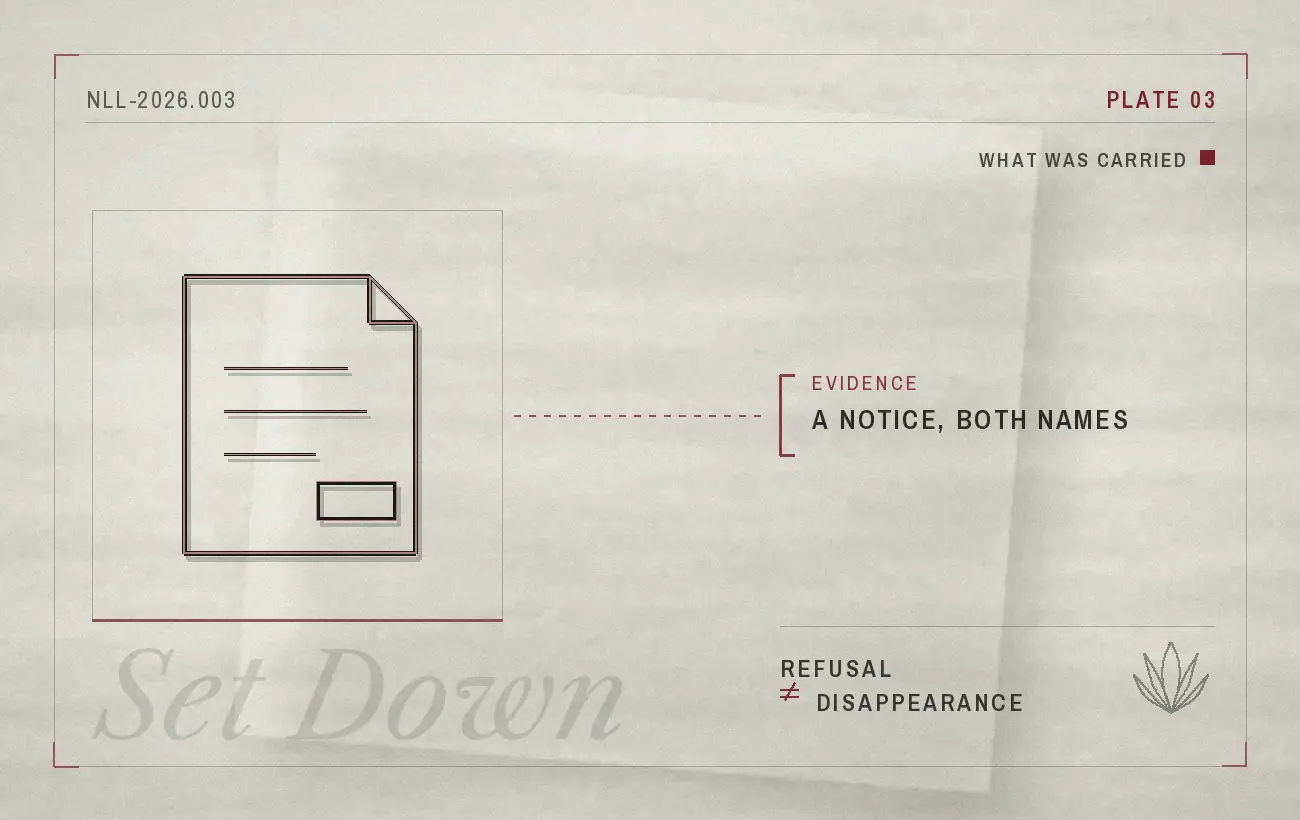
Featured finding
Nothing Is Ever Set Down
A household where burdens seem to belong to no one until they land with the person most willing to keep things from falling apart. The speaker first reads the imbalance as bad timing. Later she sees a system: one person’s freedom made possible by another’s absorption.
Refusal≠Disappearance
A responsibility refused by one person does not vanish. Like water, it settles wherever it can.
06The Forensic
Lyrical MethodTM
The Forensic Lyrical Method™ returns to concrete experience and examines it again. It asks what was believed at the time, what later became visible, and what can finally be understood when something previously difficult to name is given clearer language.
Its purpose is not to resolve the situation, but to resolve its meaning, using compassion as a method and pursuing comprehension without consolation.
The Forensic Lyrical Method is Nadia Luong Studio’s proprietary poetic-inquiry framework.
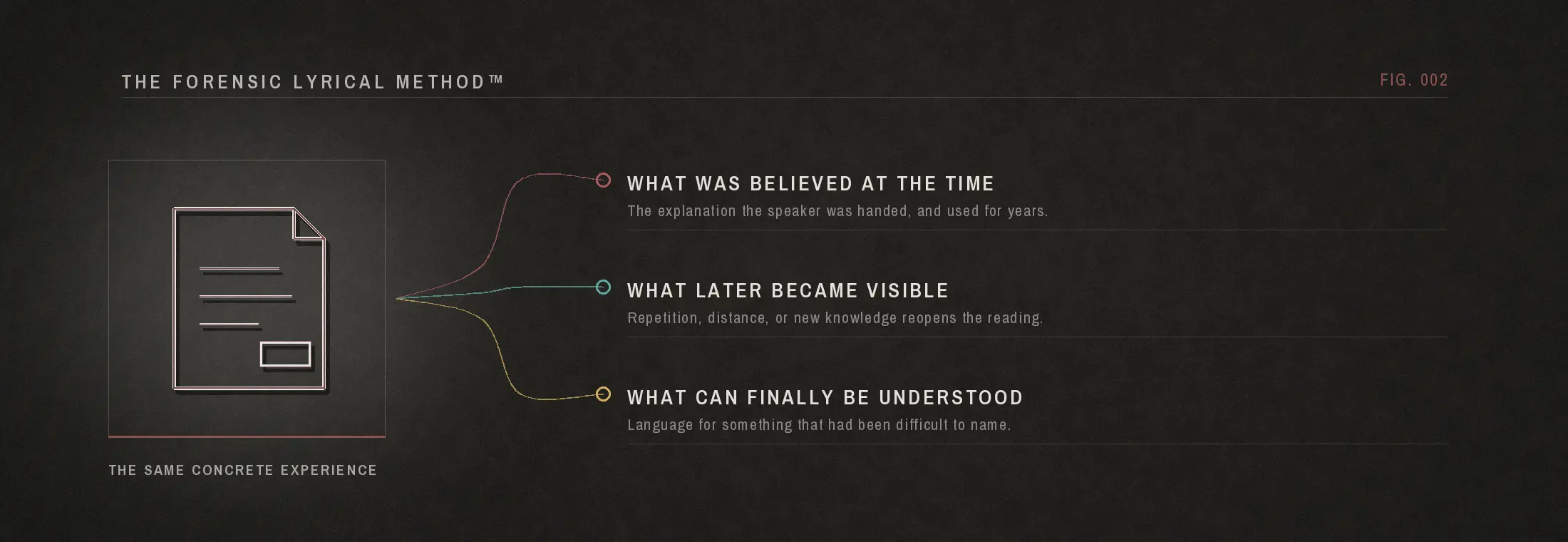
·The Method
What was believed at the time
The explanation the speaker was handed and used for years. Bad luck. A difficult season. Bad timing. It holds because it is the kinder reading.
·The Method
What later became visible
Distance, repetition, or new knowledge makes the first explanation insufficient. The same evidence is read a second time and will not sit still.
·The Method
What can finally be understood
Language arrives for something that had been difficult to name. The understanding changes the meaning of everything gathered before it, without repairing the situation itself.
Caretaking≠Childhood
So They Could Remain Children — a child’s competence can be read as proof that nothing is wrong.
When≠Whether
The Years Between When and Whether — two people answering different questions.
Refusal≠Disappearance
Nothing Is Ever Set Down — a responsibility refused only changes location.
The poem resolves the meaning,
not the situation.
The purpose of the investigation is not prosecution. It is understanding.
Compassion is not the conclusion of the investigation. It is the way the investigation is conducted.
Comprehension without consolation. Truth without manufactured repair. Forensic Lyrical Writing DNA, Version 2.0 — September 2026.
07For educators & institutions
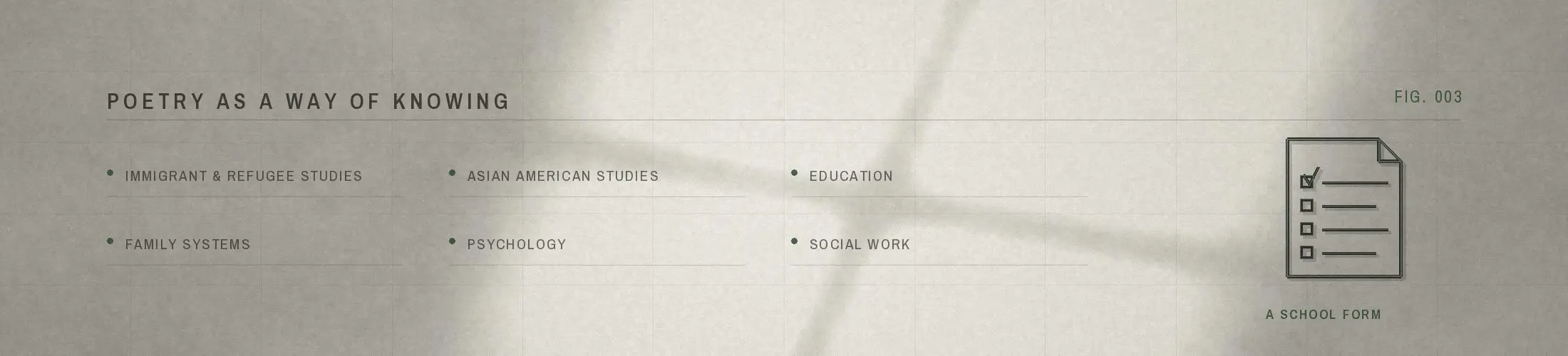
Poetry
as a way
of knowing.
The Nadia Luong Living Library is a curated body of poetry and curriculum-ready teaching resources that transforms witnessed, observed, and experienced life into sustained intellectual inquiry.
The poems invite students to examine Cambodian American identity, immigrant and refugee experiences, child language brokering, intergenerational responsibility, family systems, caregiving, gendered labor, addiction, cultural memory, and the meaning carried by ordinary objects and experiences.
Through the Forensic Lyrical Method™, students move beyond identifying a poem’s theme. They examine its evidence, reconsider what was initially believed, identify what becomes newly visible, articulate the central distinction, and arrive at a more precise understanding.
These poems can be incorporated into existing courses without requiring a full syllabus revision. They may be taught as primary texts, paired with academic scholarship, or used for classroom discussion, reflective writing, research, practicum preparation, and interdisciplinary analysis.
07.1
Selected poems for teaching
Four records01 The Lessons I Never TookA Cambodian American daughter reflects on the lessons and opportunities she did not receive while learning to navigate responsibilities created by her family’s refugee and immigrant circumstances.
Intellectual value
The poem distinguishes survival from opportunity. It asks students to consider how an immigrant child’s competence may be praised without examining the necessity that produced it, or the developmental experiences that competence displaced.
Relevant fields
Asian American Studies, Immigrant and Refugee Studies, Education, Childhood Studies, Sociology, Social Work, Family Studies, and Language Brokering.
Central inquiry
What becomes visible when a child’s early capability is understood not simply as achievement, but as evidence of responsibility assumed without meaningful choice?
02 The Sewing Machine in the AtticAn ordinary household object becomes an archive of maternal labor, economic survival, care, sacrifice, and immigrant family history.
Intellectual value
The poem demonstrates how material objects can preserve histories that were never formally documented. It allows students to examine how women’s labor, particularly labor performed inside immigrant households, can remain essential while also becoming culturally and historically invisible.
Relevant fields
Asian American Studies, Women’s and Gender Studies, Labor Studies, Material Culture, Immigration Studies, Family Studies, Sociology, and American Studies.
Central inquiry
What can an ordinary object reveal about labor, love, economic necessity, and family history when it is examined as evidence rather than background?
03 Emergency ContactAn adult daughter continues completing medical forms and navigating healthcare systems for parents who arrived in the United States as Cambodian refugees. What appears to be a routine act of assistance reveals a lifelong structure of language brokering, transportation, caregiving, and institutional responsibility.
Intellectual value
The poem expands the study of child language brokering beyond childhood and beyond direct translation. It asks when a learned ability becomes a permanent family assignment, and how institutions rely upon family members to carry responsibilities that often remain unnamed.
Relevant fields
Medical and Health Humanities, Nursing, Social Work, Sociology of Care, Public Health, Asian American Studies, Refugee Studies, Gender Studies, Family Systems, and Language Access.
Central inquiry
When does helping become responsibility, and what remains unseen when institutions interpret family caregiving as an ordinary private arrangement?
04 So They Could Remain ChildrenThe poem examines what happens when addiction and family instability require children to assume emotional or practical responsibilities beyond their years.
Intellectual value
The poem helps students distinguish maturity from parentification. It questions the tendency to praise children for being responsible without examining the circumstances that required them to become responsible, or what they were prevented from receiving as children.
Relevant fields
Psychology, Social Work, Counseling, Addiction and Recovery Studies, Childhood Studies, Family Systems, Education, Sociology, and Trauma-Informed Practice.
Central inquiry
What does adult praise for a child’s strength conceal about the conditions that made such strength necessary?
Classroom applications
- Close reading and textual analysis
- Interdisciplinary discussion
- Reflective and analytical writing
- Connections between poetry and academic scholarship
- Case-based inquiry in professional programs
- Examination of family, cultural, and institutional systems
- Practicum or internship preparation
- Projects, presentations, or supplemental assignments
Course teaching packages
Course Teaching Packages give educators a structured pathway for bringing selected Living Library poems into their classrooms. Depending on the module, materials may include authorized instructional use of the designated poem, a Teaching Companion and Instructor Quick Guide, contextual and intellectual framing, discussion questions, interpretive guidance, classroom activities and writing prompts, and evaluation and feedback materials.
Course Teaching Package License
$295
One instructor, one course section of up to 35 students, one academic term. Full written terms accompany the package.
Bring the Living Library
into your classroom.
Explore selected poetry, request teaching materials, or inquire about an author visit, classroom conversation, or institutional program.
08From the archive
The earlier work shows where the method began.
The first phase of the Library used denser metaphor and more elevated lyrical language, and it ended where a reader could be held. Those poems are preserved as written. They document the origin of the voice and the turn from emotional recognition toward forensic discovery. Not every poem in the archive is a forensic lyrical poem.
The vocabulary became simpler
as the architecture became more exact.
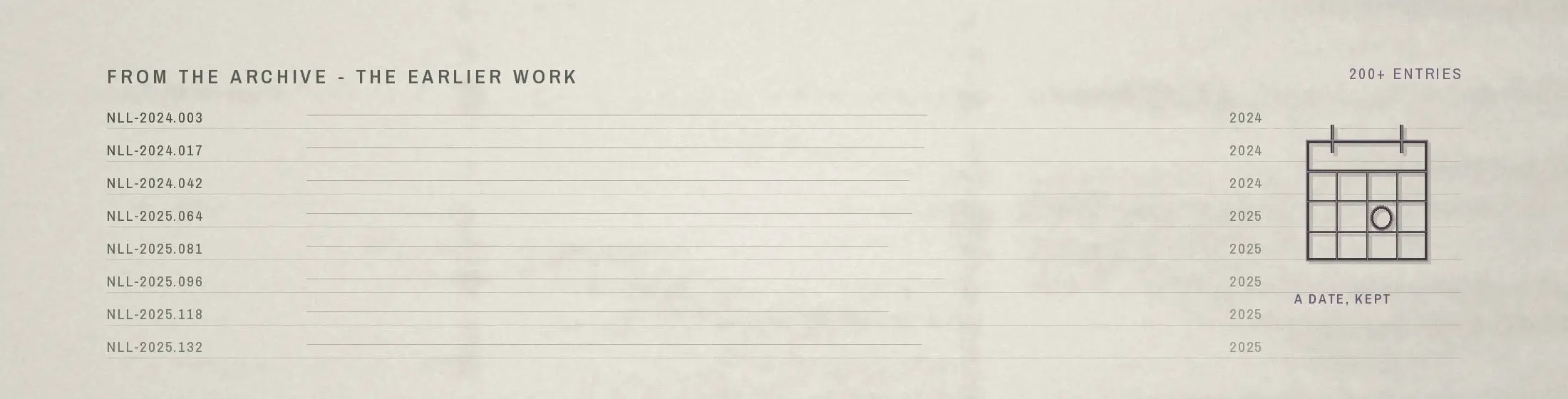
NLL–2025.096The Shape of Your AbsenceEarly lyric — the provider parent2025
NLL–2025.081You Never Saw Me for Who I AmEarly lyric — reclamation2025
NLL–2025.064Guilt, and What It Left BehindEarly lyric — carried guilt2025
NLL–2024.042The Love That Turned Me Toward the HorizonEarly lyric — direction2024
NLL–2024.017The Shape of My BecomingEarly lyric — endurance2024
NLL–2024.003Your Heart Will Live Outside of YouEarly lyric — first collection2024
09
Get letters from the Living Library.
Occasional updates on the poetry, the work behind it, and new publications. For teaching materials, speaking, or licensing, write to the studio instead.
10Enquiries
Write to the studio.
For teaching materials, classroom pilots, speaking, licensing, press, or anything else. Nadia reads every enquiry herself and replies within a few days.
- Course Teaching Packages and discussion materials
- Author visits, readings, and classroom conversations
- Licensing for course readers and anthologies
- Press, interviews, and institutional collaboration